
Projection of planes is a fundamental topic in Engineering Graphics that helps students understand how flat surfaces (planes) are represented on a two-dimensional drawing sheet. Mastery of this concept is essential for visualizing objects and solving graphical problems accurately.
A plane is a flat surface having only length and breadth, with negligible thickness. In Engineering Graphics, planes are usually classified based on their position with respect to the Horizontal Plane (HP) and Vertical Plane (VP)—such as planes parallel to HP, parallel to VP, inclined to one plane and perpendicular to the other, or inclined to both HP and VP.
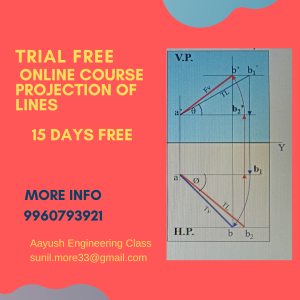
When a plane is parallel to HP, its true shape appears in the top view, while the front view appears as a line. Similarly, when a plane is parallel to VP, the true shape is seen in the front view, and the top view reduces to a line. As the plane becomes inclined to one or both reference planes, the projections become shorter and require step-by-step construction methods to find the true shape and true inclination.
Understanding the projection of planes builds a strong foundation for advanced topics like projection of solids and development of surfaces. With regular practice and clear concepts, students can easily visualize complex engineering drawings and improve their problem-solving skills.
At Ayush Engineering Online Classes, we simplify topics like projection of planes using clear explanations, solved examples, and exam-oriented methods to help students learn with confidence.